|
 |
The purpose of this project is to create a community educational center that embodies the entire concept of Ahupua’a Resource Management, which is to take care of all living things from the mountains to the ocean. (An Ahupua’a is an ancient Hawaiian land division system, which contained strips of land that extended from the mountain to the sea. The Ahupua’a supported a self-contained community working with a spirit of cooperation of caring and revering the land and ocean to meet the needs of all.) |
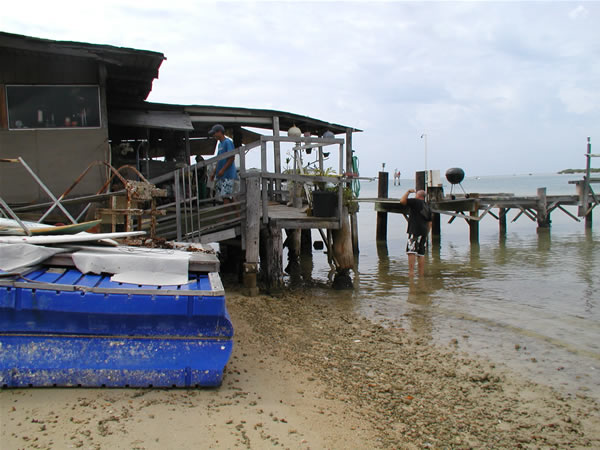
In 2004, Kai Makana became involved in the on-going restoration project located on Mokauea Island. Mokauea Island is located in Keehi Lagoon, between Honolulu Harbor and the Honolulu International Airport on the Island of O’ahu. The island is proximately half a mile from an area on O’ahu called Sand Island within the City limits of Honolulu. The island is approximately 10 acres during low tide.
This restoration project was initially started in 1975 with the purpose consistent with that stated above. Over the last 30 years progress towards creating a viable subsistence educational center was made on the island. However, during the 1990’s political change, educational and non-profit organizational shift in priorities, and island family dynamics resulted in a decline in project participation.
| Kai Makana has signed up to be a partner and help lead this project from 2004 to 2010 and has promised to always be a part of restoring and maintaining this island as long as the families of the island request this assistance. Kai Makana’s goal is to create an environmental educational center where students, parents, teachers, educational institutions, other non-profits, and basically anyone can come and participate on an island that is considered to be the last fishing village in the State of Hawai’i. It is our hope that people will view this island as a small microcosm of what we, as humans, face environmentally as well as what we can do if we work together to change our environmental climate. If we can take a small island and turn the environmental impacts around in order to help the 5 remaining fishing families regain their subsistence living, then maybe there will be hope for us around the world. |
|
 |
In 1975, Mokauea Island had a minimum of 14 fishing families. This island contained a fishing community, whose cultural/heritage roots extend to pre-historic times. The island used to be self-sufficient due to a working aquaculture fishpond, farming of taro, green onions, eggplant, tomatoes, chili plants and some medicinal plants including aloe, as well as limu (seaweed) and a healthy supply of reef fish. This was an island that needed nothing more than a consistent environment and respect by all others. |
Currently, Mokauea has 5 resident fishing families. The fishpond is overgrown with mangrove, there is no viability for farming as thorny Keawe trees have taken over the island, no eatable limu as the invasive gorilla seaweed has killed the native limu and no viable healthy fish as other non-island fishermen have raided the island’s fishing areas. In addition, these families wake up each day to garbage on their doorstep, brought to them by the changing tides of the ocean but ultimately from humans in O’ahu as well as other islands in the Pacific. Broken glass, plastic bags, old TVs, bike parts, beer cans and bottles are a common site each day and the sad thing is that it is not from any of the families.
Kai Makana’s goal is to involve as many people, organizations, educational institutions and communities as possible by conducting the following:
-
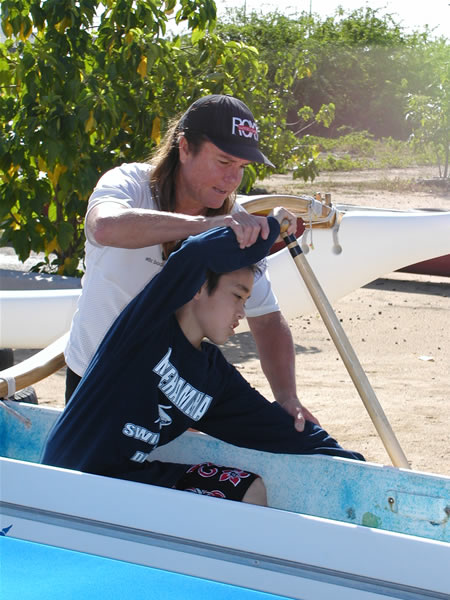
Teaching Hawaiian outrigger canoeing in order to teach unity in working together, to travel via a noon-fossil fuel vehicle to another island (Mokauea), to show the participants ocean life such as dolphins, turtles and native fish in the area as well as pick up garbage floating in the ocean. The hope is that the participants will see the animals and begin to connect with the responsibility of having them. In addition, that there is a need to pick up garbage as it can be deadly to our ocean marine life. We currently have no canoe of our own and are looking for funding for this environmentally friendly marine vehicle.
-
Water quality testing in order to teach participants the need to know what is in our ocean. If we have a huge amount of land runoff, we see through the tests that there is a high number of nutrients and a low level of dissolved oxygen, which means that the fish are having a hard time breathing. We teach that the ocean maybe beautiful, but that it is necessary to test it as we may not know if it can sustain life due to what we do on land. Testing has indicated that the island has a good source of dissolved oxygen and that runoff does not appear to reach the island eco-system.
-
Limu restoration in order to show the basic need of any ocean eco-system, which is limu or seaweed. Without it, no fish would be able to feed and live. In addition, native limu is a viable eating source for humans as well as a medicinal resource. We have located one small type of native limu and are currently restoring it on the west side of the island. In addition, we are removing the invasive gorilla limu.
-
Historical and cultural information pertaining to the island in order to inform participants that this is our last fishing village and that we need to restore it or we may become as extinct as it.
-
Marine debris collection and data analysis in order to give a clear view of what is floating around in our ocean and how most of it is man made. On this island plastic and glass are the biggest items.
| The plan is to continue to do outreach, teach others about the need for dissolved oxygen in our ocean specifically this island, remove keawe trees, restore limu to a viable level, build a structure in the center of the island for weekend environmental retreats as well as star navigation study, repair island docks for equipment to arrive via motor boats, create a recyclable collection system for the island. At the end of 2010, funding and leadership roles will change to the University of Hawaii to implement the restoration of the Mokauea Fish Pond |
|
|
|